Older traditions
Long before apps and browsers, people used coins and other small objects as a neutral way to settle disputes when two choices felt evenly matched.
 CoinToss
History
People have been using coins to settle choices for a long time. If two outcomes are equally likely, a flip is an easy way to call it.
That has covered pub arguments, small wagers, starting games and deciding who goes first. Sport made the toss a normal part of the routine, and online tools carry the same habit into the browser.
Try the coin toss
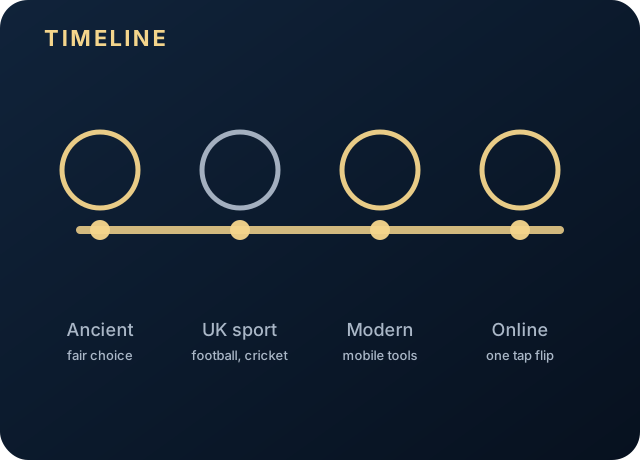
The details changed over time, but the idea stayed the same: make one fair choice and move on.
Long before apps and browsers, people used coins and other small objects as a neutral way to settle disputes when two choices felt evenly matched.
People used coin flips in arguments, games and informal wagers because the result was easy to explain once the coin landed.
Football and cricket turned the toss into a visible ritual. Captains still use a coin to decide who starts first or chooses an end.
Modern coin toss pages keep the same 50/50 logic, but you do not need a coin in your pocket. That makes them handy on mobile, in classrooms and for quick decisions in a browser.
In the UK, coin tossing is tied closely to football, cricket and the general idea of settling a choice quickly. That is why heads or tails still feels so familiar.
The pre-match toss decides kick-off or ends. It is one of those small match-day rituals people barely think about until it is missing.
Captains use the toss to decide whether to bat or bowl first, so the coin is part of the strategy, not just a bit of theatre.
Outside sport, “heads or tails” still works as shorthand for a fair choice in pubs, classrooms, offices and group decisions.
A simple flip has settled some massive decisions when no other tie-breaker was available.
Founders Asa Lovejoy and Francis Pettygrove used a best-of-three coin toss to decide the name of their new city. Pettygrove won the toss, meaning the city was named Portland rather than Boston.
Wilbur and Orville Wright flipped a coin to determine who would attempt the first powered flight. Wilbur won, but stalled on his attempt. Orville achieved the successful first flight three days later.
After two draws and a drawn playoff match in the quarterfinals, the tie was settled by a coin toss. Liverpool captain Ron Yeats famously won the toss, advancing his team to the semifinals.
In the European Championship semi-final, Italy and the Soviet Union drew 0-0 after extra time. With no penalty shootouts in the rules yet, Italy won a coin toss to advance, eventually winning the tournament.
A famous NFL officiating error occurred during an overtime coin toss between the Steelers and Lions. The referee misheard Jerome Bettis's call. The ensuing controversy led the NFL to change how the call is made prior to the flip.
While we treat it as perfectly random, physics tells a slightly different story.
Recent massive studies involving hundreds of thousands of flips have confirmed a slight "same-side bias". Because of a phenomenon called precession—a wobble in the coin's flight—the coin has a slight tendency to land on the same side it started on.
The probability is approximately 50.8% rather than a perfect 50.0%. However, because human flippers lack the mechanical precision to control the exact force and height, a coin flip remains the gold standard for a fair, impartial decision in everyday life and professional sports.
The phrase re-entered modern pop culture in a massive way thanks to a hit fantasy song.
In 2019, the Netflix original series The Witcher released the song "Toss a Coin to Your Witcher", performed by Joey Batey as the bard Jaskier. It became an instant viral sensation.
The catchy tune brought the concept of tossing coins as payment and goodwill to the forefront of internet culture, resulting in countless covers, memes, and remixes. The phrase itself is now one of the most recognizable modern references to coin tossing in media.
Different countries tend to use the coin that feels normal locally. The logic stays the same even if the denomination changes.
British coin
The familiar UK default for a quick online toss.
US quarter
A common US choice when people want a fast flip.
Canadian loonie
A familiar Canadian option for an online coin toss.
Euro coin
Often the natural choice for users across Europe.