
Why several Zhou-era Chinese states cast their money in the shape of spades and knives, how those coins actually worked, and why a round copper coin with a square hole replaced all of them in 221 BC.
Western coinage settled almost immediately on the round disc. China took several centuries of experimenting to get there, and for much of that time its money was cast in bronze in the shapes of the tools people already understood: spades in the central plains, knives in the north-east, cowrie shells and bolts of silk before and alongside both. The British Museum holds striking examples of each. Reading them side by side tells you something unusual about early money: it was not one invention but a set of local answers to the same question.
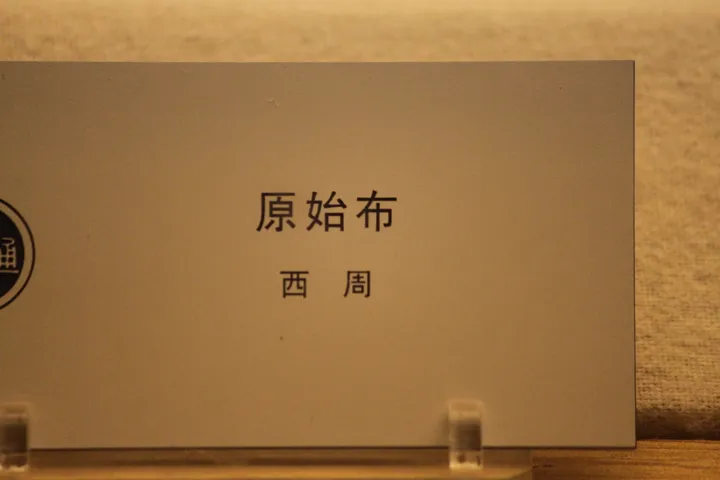
Before coins: shells and silk
The oldest Chinese money was not metal at all. Cowrie shells served as currency in Shang China by around 1300 BC, and the Bank of England's money timeline notes that the cowrie survives inside the written language itself: the shell radical 贝 appears in Chinese characters for money, value, and wealth. Inscriptions also record the peng, a string of cowries used as a counting unit, and silk bolts exchanged by graded length. Cloth money was so durable a convention that Yale historians Valerie Hansen and Xinjiang Rong documented textiles serving as currency on Silk Road contracts as late as the Tang dynasty, a tradition well over a thousand years old by then.
Spade money: from the field to the mint
The central states of the Zhou world, the territory of the old state of Jin and its successors, cast money shaped like spades. The mainstream account, laid out in Wang Yü-ch'üan's Early Chinese Coinage for the American Numismatic Society, is that these began as miniature metal versions of actual digging tools. The earliest "original spades" were hollow-handled: the socket where a wooden shaft would fit is still there on the coin. Later issues flattened the handle away entirely and became thin inscribed blades that no one could dig with, classified by collectors by their foot shapes: square-foot, pointed-foot, and round-foot spades, usually stamped with the city that issued them.
Two cautions belong here. First, the dating of the earliest spades is contested; scholars disagree on whether they begin in Western Zhou, the Spring and Autumn period, or the early Warring States era. Second, some surviving pieces are oversized or impractical in ways that have led numismatists to suggest ritual or burial copies rather than working currency. The tool-to-money story is the mainstream reading of the evidence, and it is still a reconstruction.
Knife money: the north-east's answer
The states of Qi, Yan, and Zhao in the north-east cast money shaped like knives, with a ring at the pommel end and a blade inscribed with its issuer. The best-known type is Qi's three-character knife reading Qi fa hua, "the standard currency of Qi", cast at the capital Linzi. These are substantial objects: the British Museum's examples (registration numbers 1883,0802.14 and 1883,0802.15) measure 180 and 186 millimetres and weigh around 47 and 48 grams. They carry no face value; like early Greek coins, they were evidently counted as pieces rather than read as a denomination.
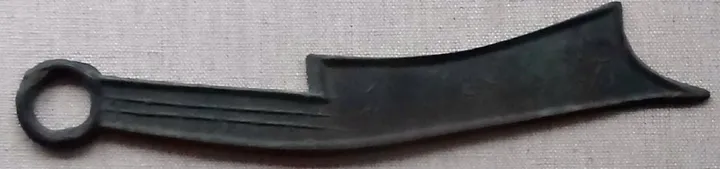
Yan's commonest knife carries a character usually read as ming, though the reading is debated; some scholars argue it names the state of Yan itself rather than the word for "bright". Knife money circulated in the north-east from roughly the sixth century BC until the Qin unification, and hoards show knives strung together in large numbers, which fits the ring at the pommel being made for exactly that. One caveat: the neat story of merchants threading knives onto cords for easy carrying is reconstructed from hoard finds, not from a written description of the practice.
The empire rounds everything off
What ended the experiments was unification. When Qin Shi Huang conquered the other Warring States in 221 BC, he standardised the currency on the round bronze ban liang ("half liang") coin with a square hole in the centre, a type already current in Qin itself. The round coin with the square hole then stayed in production, in evolving denominations, for roughly two thousand years. The traditional explanation that the shape represents round heaven over square earth is a later gloss; the practical virtues, easy stringing and easy casting, are enough to account for it.
Knife money did get one strange afterlife. Wang Mang, the Han official who usurped the throne in 9 AD and launched a wave of monetary experiments, revived archaic shapes including a knife with the words "one knife" inlaid in actual gold, declaring it worth five thousand cash. The British Museum holds one (registration 1996,0217.239, 71 millimetres of bronze with gold inlay). The Han shu's treatise on food and money records the reform chaos that followed. Token money with an inflated face value was as old as the tool coins, and just as hard to sustain.
Five monies, one table
| Money type | Material | Where and when |
|---|---|---|
| Cowries | Marine shell, later bronze imitations | Shang and early Zhou, by c. 1300 BC |
| Silk bolts | Woven textile, graded lengths | North China; still used as currency into the Tang |
| Spade money (bu) | Cast bronze | Central states (Jin successors), c. 7th–3rd century BC |
| Knife money (dao) | Cast bronze | Qi, Yan, Zhao, c. 6th–3rd century BC; revived 7–14 AD |
| Round cash (ban liang) | Cast bronze | Qin, standard from 221 BC, template for two millennia |
Sources & References
- British Museum object record 1883,0802.15: Qi fa hua knife money, 186 mm
- British Museum object record 1996,0217.239: Wang Mang's gold-inlaid knife
- British Museum object record 1996,0612.22: Zhao-state spade money
- British Museum object record 1909,0511.5: hollow-handled spade money
- Wang Yü-ch'üan, "Early Chinese Coinage", American Numismatic Society (1951): the standard account of the spade-to-coin evolution
- Peng Xinwei, "A Monetary History of China", translated by Edward H. Kaplan, Western Washington University (1994)
- Hanshu, Treatise on Food and Money (Chinese Text Project): Wang Mang's monetary reforms
- Bank of England, "How has money changed over time?": cowries and the shell radical in Chinese writing
- Valerie Hansen and Xinjiang Rong, "How the Residents of Turfan Used Textiles as Money, 273–796 CE" (Yale University)
- Image: spade money, Wikimedia Commons, CC0
- Image: Qi fa hua knife money, Wikimedia Commons, CC BY-SA 3.0
The dating of the earliest spade money, the reading of the "Ming" character on Yan knives, and the exact path from tool to coin are all debated by scholars, and this article presents the mainstream account with that disagreement acknowledged. Reviewed against these records on 7 September 2026. If a date, figure, or interpretation needs correction, please contact hello@cointoss.uk.